The product links in this guide are ordinary sourcing links. ARCH-S does not currently earn a commission through them. How we select products.
Compare the starting points
US sourcing options
Compare the exact product, configuration and delivery destination with the supplier. A product family is a starting point for selection, not an approval for every project.
Stoneyard
Colonial Tan Ledgestone Thin Veneer
- Material
- Natural stone; individual strips, not panels.
- Size / configuration
- Flats: 1–4 in high, 4–12 in long, 0.75–1.25 in thick, per supplier.
A warm, layered horizontal texture for comparison with lighter walls and earthy palettes.
Before ordering: Natural color variation and mica sparkle; sample, project assembly, freight and installed result require confirmation.
View manufacturer / retailerStoneyard
Boston Blend Ashlar Thin Veneer
- Material
- Natural split-face stone; individual pieces.
- Size / configuration
- Flats: 3–7 in high, 4–14 in long, 0.75–1.25 in thick, per supplier.
A larger rectangular rhythm and a mixed gray, white, blue and tan palette.
Before ordering: Stone may be field trimmed; lot, joint pattern, corner quantities and suitability of the complete wall remain project-specific.
View manufacturer / retailerEldorado Stone
Cliffstone
- Material
- Manufactured stone veneer profile.
- Size / configuration
- Published flats: 1.25–5.5 in high, 4–21.25 in long, 0.625–2.375 in thick; corners available.
A flatter-faced manufactured alternative to compare through a local dealer.
Before ordering: Official route redirects to Westlake Royal; regional color availability, price and installation terms must be checked with the dealer.
View manufacturer / retailerChoose the size of the visual rhythm
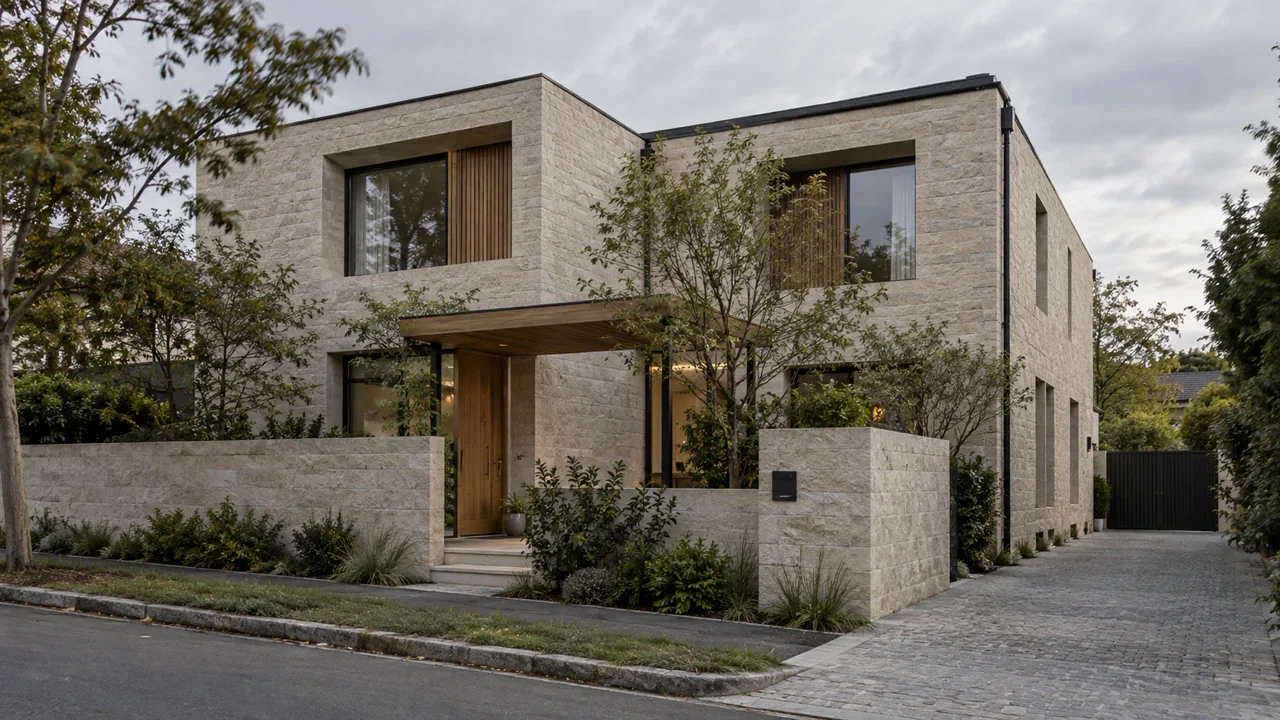
Start with the building's overall proportions. Long, low pieces reinforce horizontal lines and can work with deep eaves or a low garden wall. Taller ashlar pieces create a broader masonry rhythm and fewer narrow courses. An irregular mosaic produces a different character again. Hold those choices against the size of windows, the spacing of columns and the distance from the street, rather than selecting a texture in isolation.
Stoneyard's Colonial Tan Ledgestone consists of individual strips, while Boston Blend Ashlar uses taller, roughly rectangular pieces. Neither is sold as a preassembled stone panel. That difference matters when estimating laying time and judging how much the finished appearance depends on the mason's selection and arrangement. Include the intended joint treatment in a sample panel: a recessed joint and an over-grouted finish can make the same stone feel like different materials.
Understand what natural and manufactured veneer mean
Natural thin veneer is stone cut to reduce its depth. Stoneyard identifies its range as real natural stone and publishes approximately one-inch thickness for the two products compared below. Its Colonial Tan palette combines browns, beige and gray with mineral sparkle; Boston Blend has a cooler mixed palette. Variation is part of the selection, so ask for several pieces rather than relying on one small chip.
Eldorado's Cliffstone is a manufactured veneer profile with flatter faces and a range of piece sizes. The official page provides flats and corner dimensions and directs buyers to local distributors. It is a separate material family, not quarried stone. Compare its sample panel, color consistency, available corners and lead time with the natural options. A nationwide brand presence does not mean every color is available in every region; the page itself can display regional availability restrictions.
Treat corners and openings as purchase items
Measure corners in linear feet and flat areas in square feet, keeping those quantities separate for the supplier. Confirm how a corner unit changes the required flat quantity. Draw the returns at doors, windows and exposed wall ends, and decide whether the material wraps, stops at a trim or returns to a different finish. A thin face cut left visibly exposed at an edge can undo the sense of depth you wanted.
Ask about sills, caps and transitions to siding or stucco at the same time. Their profiles, projection and drainage details can affect the elevation more than a small change in stone color. Include waste and spare material, but ask the installer and supplier to set the allowance for the actual shape and layout. A generic percentage should not replace a measured takeoff for a wall with many small returns.
Approve the assembly, not just the face
Stone is not the building's water-management system. Ask the local design and installation team to identify the wall substrate, attachment method, drainage and flashing details, clearances and movement accommodation for the specific project. Confirm that the selected mortar or mechanical system is intended for that stone, substrate and exposure. The support assessment must account for the complete installed assembly rather than the dry stone alone.
Request current technical information for the actual product and lot where relevant. Exposure to freeze-thaw, persistent wetting, salt or irrigation deserves a specific discussion, not an assumption that all stone behaves alike. Stoneyard's HCA label is its proprietary designation, not an independent industry certification. We do not use that label to certify a project. A local professional should resolve the assembly before procurement and review the representative sample panel.
Compare delivered and installed cost
Ask each supplier to quote the same scope: selected profile and color, flats, corners, caps, freight to the ZIP code, unloading and any sample or minimum-order charges. Keep installation and substrate preparation visible as separate items. Thin veneer can reduce depth compared with full-bed masonry, but it still carries real weight and requires an appropriate wall and installation method.
View a multi-piece sample outdoors, both dry and damp, next to the actual roof, window and adjacent wall colors. Ask how the sample relates to the production batch and inspect delivered material before installation. Reserve the supply and confirm access for freight before booking labor. If a dealer or supplier introduces a mason, establish that mason's scope directly; a recommendation is not confirmation that installation is included in the material order.
- Request flat and corner quantities separately.
- Obtain a sample panel showing the selected joint treatment.
- Confirm current regional availability, freight, unloading and return conditions.
Sources & further reading
- Stoneyard natural thin veneer range and nationwide supply ↗
- Colonial Tan Ledgestone specifications ↗
- Boston Blend Ashlar specifications ↗
- Eldorado Cliffstone manufacturer page ↗
Product references checked 17 November 2026. Prices, variants, availability and delivery terms can change; confirm the exact specification and destination before ordering.
Need help with the whole space?
Share your ideas, references or plans with ARCH-S. We can help connect the individual choices to your architectural brief.
Arrange a free 30-minute conversation ↗